
Sonicator Safety
Triple Trouble! Aerosols, noise and electricity.

Objective:
To mitigate the risks of permanent hearing damage and the inhalation of hazardous aerosols or pathogens during high-energy sample preparation.
The Prep
Inventory PPE: Ensure the lab staff has access to well-fitting earmuffs or disposable earplugs. Earplugs are generally the better call for hygiene and logistical reasons (“where’d the earmuffs go again?”) and as a bonus you can hand them out while you’re talking.
Audit Disinfection: Biological labs need a 70/30 ethanol/water mixture or other validated disinfectant for the probe tip and the bath water. It’s also useful for the earmuffs if they’re communal.
The Briefing
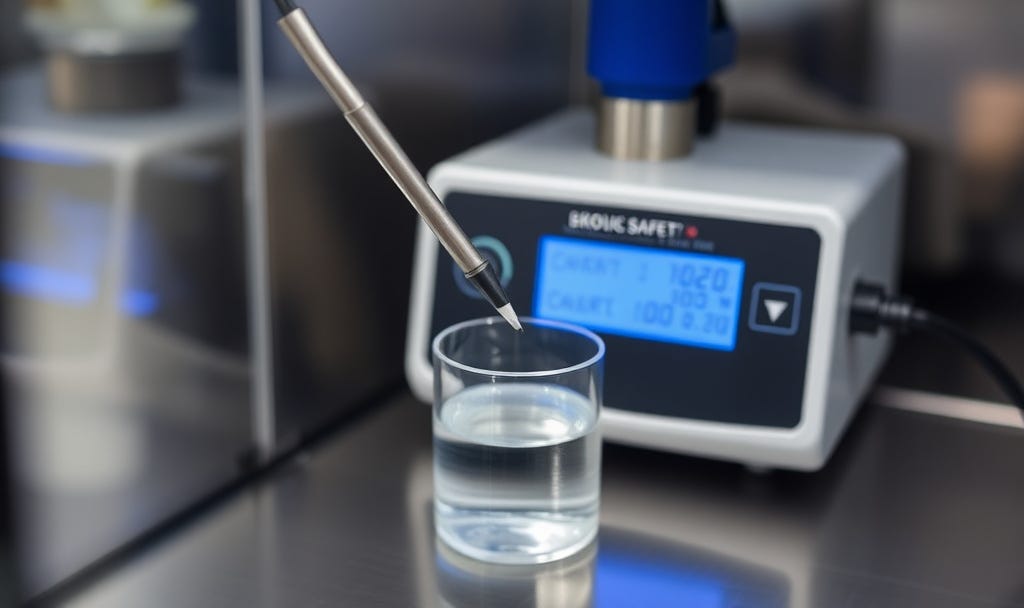
Today we’re talking about sonicators—tools that use high-frequency sound waves to disrupt cells or mix samples. There are primarily two different types of sonicators - probe sonicators and bath sonicators. They accomplish mostly the same goal at different sizes. It’s an effective process, but creates two major hazards: noise and aerosols.
First, the noise. OSHA requires hearing protection - administrative controls, PPE, enclosures, whatever - when noise at work exceeds 90 dB. One sonicator running well is not likely to do this on its own. However, when they get old or the bath-type sonicators are running on water levels below the indicated mark, they get louder and can get very close to the 90 dB range. Put two or three of these together in close proximity and you have a noise hazard that anyone with migraines will instantly recognize. Even if the sound doesn’t seem too bad or ‘painful’ to you, prolonged exposure to the high-frequency pulses of a sonicator can cause permanent hearing loss.
If you don’t have to stand right next to a sonicator while it’s operating for other reasons, get some distance. As little as a meter of distance can give you a noticeable 2-3 dB of relief. If you must stand nearby an operating sonicator to observe or control the process - or because someone else is running one - earplugs are highly recommended. Finally, ensure that bath sonicators are operating at their indicated liquid level. Not only does this ensure good even propagation of the ultrasonics throughout the bath, it muffles the intensity of the noise coming off the equipment. You’ll want to disinfect or replace this water on a weekly basis as well - it can and will get pretty gross.
Second, the less noticeable risk: aerosols. This is more of a problem for probe sonicators than bath sonicators. Bath sonicators are usually housing closed glassware where probe sonicators, at least in the absence of fitted lids, have to leave the liquid exposed to the ambient air. The energy used to cavitate liquids can create a fine mist of whatever you are processing. Always try to get the sonicator tip down as far into the liquid as is reasonable to both fully process the material and minimize the amount of aerosols being thrown off. If you are sonicating hazardous chemicals or infectious agents, the sample must be in a sealed container or the entire unit must be inside a fume hood or BSC.
If it any point you feel that your workspace is too noisy - whether it’s due to sonicators or not - don’t hesitate to have EHS come out and take some sound level readings. That’s why we’re here.
From Past Experience
Labs of all kinds, with very few exceptions, are sleeping on the noise generated by their sonicators (which seems difficult given how loud they are! ha!). There will usually be a general sense that “wow, these things are annoying” but rarely will someone have shown up with a testing device and actually determined some real numbers. Labs will often employ one of two strategies to deal with the noise generated by sonicators, each with its own strengths and weaknesses:
Spread them out. This is the more common tactic. Don’t keep any two sonicators near each other. On the upside, you’re highly unlikely to ever cross into dangerous noise territory this way. On the downside, you need a lot of random benchspace and it’s going to low-level irritate everyone in the lab at times since there’s nowhere to go to escape on busy days.
Sonicator closet. Doesn’t actually need to be a closet. Put all the sonicators in one spot and mandate hearing protection for walking into that room/area. I prefer this given the option - it strongly highlights the value of hearing protection and consolidates the hazard to a single location. Not all labs can do this. Try not to put multiple probe sonicators too near each other so liquid can’t fly out of one sample and into another. Also, you will have one or two analysts who just refuse to walk into that room/space due to sensory issues. So be it.
Sonicator enclosures - to muffle sound and contain aerosol - are great if you have the lab bench footprint for them. Also be aware that lab staff likes to put bath sonicators near sinks so they can be refilled and dumped easily. This is fine but now you’re specifically putting electrical equipment near a water source. Get GCFI outlets in those locations stat and maybe put down some absorbent mats just in case to keep the bench space as dry as possible.
P.S. Give yourself a high-five if you caught the reference in this article’s subtitle. Maybe you just have the Nack for it?
Resources (for you)
Lab Manager: Sonicator Safety: A short but comprehensive look at into the mechanical risks or sonication and the importance of sound dampening.
CDC/NIOSH: Noise and Hearing Loss Prevention: General standards on why high-frequency protection is non-negotiable in technical environments.